Staff engineers at Hinge Health: who we hire, who we don't
Felix Pageau, Sr. Dir. of Engineering · June 12, 2026
•6 min read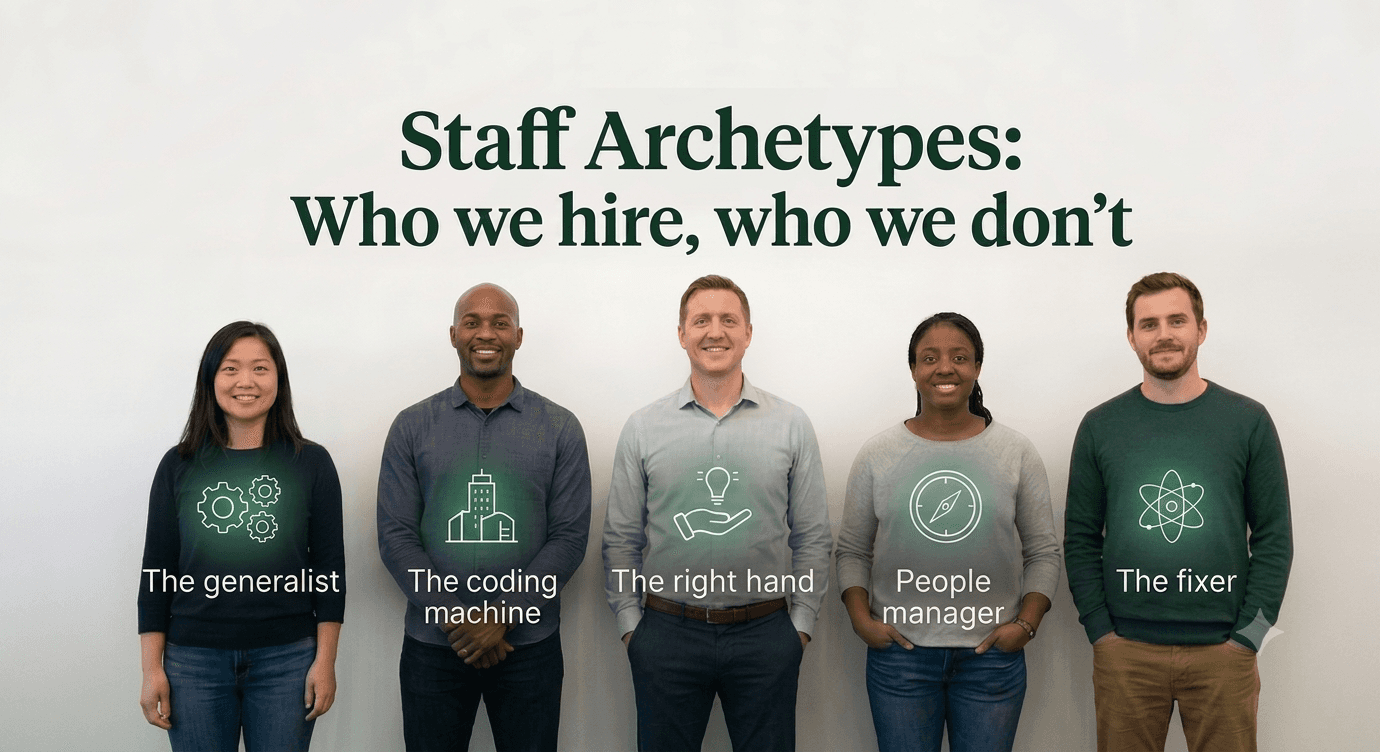
"Staff engineer" means ten different things at ten different companies. Here's what it means at Hinge Health, why, and what we expect from staff engineers here.
Why we wrote this down
Our CEO, Daniel Perez, made the argument years ago that technology alone won't transform health care. It's still true today. It is how we use technology that will change healthcare, which is why we are holding such a high bar for the staff engineers who make these decisions. We are not a software company that happens to do health care. We are using software and hardware to help people move beyond pain. It has to work for someone in pain at 6am, not in a deck, not in a diagram, but in production. That sets a particular bar for the senior technical engineers we hire.
It also makes the staff hiring decision unusually high-stakes, and unusually difficult. If the interview panel doesn't agree what the role entails, the loop falls apart. One interviewer grades architecture diagrams. Another grades coding velocity. Another grades cross-team influence. Without a clear definition of what makes a staff engineer successful at a company, you can easily hire very talented engineers and not provide the environment to thrive.
So we wrote that definition down. There are good frameworks for this: Will Larson, author of Staff Engineer, has defined four archetypes (Tech Lead, Architect, Solver, Right Hand); Facebook publishes six (Generalist, Specialist, Coding Machine, Tech Lead, Fixer, Product Hybrid). These are useful tools, but the exact framework matters less than being exceptionally clear about which subset thrives at Hinge Health.
The four archetypes we hire
The generalist. They are a force multiplier. They anchor a team, provide technical clarity and by inspiring and solving the hardest problem, they increase the productivity of every engineer around them. They don't ask permission to leave their lane because they always work on the highest ROI project and deliver impact. This is most of our Staff bench, by design. Our system has a lot of seams: concurrent care, multi-program enrollment, devices, a member journey that has to actually work. The people who have the most impact are the ones who can move along those seams without being told to. This is also the hire that keeps faith with the Learn-It-All value we run on: deep when it counts, but never so deep that they can't pivot to learning the next thing.
The coding machine. The output is the leadership. They write the hardest part of the system. While the rest of the team talks about solving hard problems, they lead by shipping the diff that solves these problems, including how to work with AI tools without losing the thread of what the system actually needs to do. Dan's argument cuts both ways here. Technology alone won't fix health care, but bad technology will absolutely break it. Coding machines deliver a "consistently high-quality experience" at scale. That requires people who build the hardest components in the simplest way possible 10X as fast as anybody else. In the AI era, that bar only gets higher. AI raises the floor for everyone, which means the top coders are now expected to operate at a level that simply wasn't possible before, going deeper into complexity.
The fixer. When a mission-critical project stalls, they are the one we call. They are already in the channel when a P0 incident starts, the one who picks up the migration when it hits a roadblock, the engineer who figures out what's wrong when the system is misbehaving in ways no one can quite explain. They have a track record of solving the thorniest, most mission-critical problems. You can recognize them by their behavior when things get tough: they run toward the mess, and keep that complexity from grinding the org down.
The specialist. They build software in a unique domain space. We only hire specialists in the areas that our business needs: Computer Vision, Hardware, ML Systems, Security, Reliability. This person raises the team's ceiling in a field where most other engineers lack expertise. The bar is the same as the other staff roles including problem solving, code contributions, and elevating their team's skills.
The four archetypes we don't hire
The staff engineer producing only paper. Three RFCs a quarter, no shipped work. This person's output is limited to outlining and organizing future work on paper. You cannot be a senior technical leader here from the sidelines. We expect our staff engineers to be hands-on contributors including writing code and solving problems.
The ivory tower architect. Sits in a cubicle drawing boxes, hands them off to a team but does not work with them to solve the problem. Instead of being a facilitator, they become a rubber-stamping process for doing any work. We look for staff engineers to accelerate problem solving and remove barriers.
The right hand. Borrowed authority, no mandate. This is a real archetype at companies of a thousand engineers. We're not that company, and we don't need the role, yet.
The tech lead who's actually managing. If most of your week is 1:1s, performance conversations, and unblocking people through their managers, that role is an Engineering Manager and we have openings. The "staff" title here has to come with the scope and responsibilities that justify it — it's not a fit for someone who's drifted off the technical track.
What success looks like
In one year as a new staff+ hire, you will have shipped major new solutions to our members. You've been shipping code in production since week one. Other engineers are trying to emulate you as a role model for their growth. You got there by being one of the top 10% technical engineers — not by managing people, not by drawing diagrams, not by producing documents — but by delivering technology that changes the lives of our members. As our CEO says, "at this level we expect you to be the tip of the spear."
In three years you'll have shipped systems that have helped millions of people reduce chronic pain, manage migraines, and return to a healthy, productive life.
A successful staff engineer at Hinge Health excels in four key areas:
- You are a senior technical contributor.
- You make code-level decisions.
- Other engineers learn from your work.
- You carry impact across teams and organizations.
That's what we're hiring for. If that sounds like you, we'd love to talk. See our open staff engineering roles.